

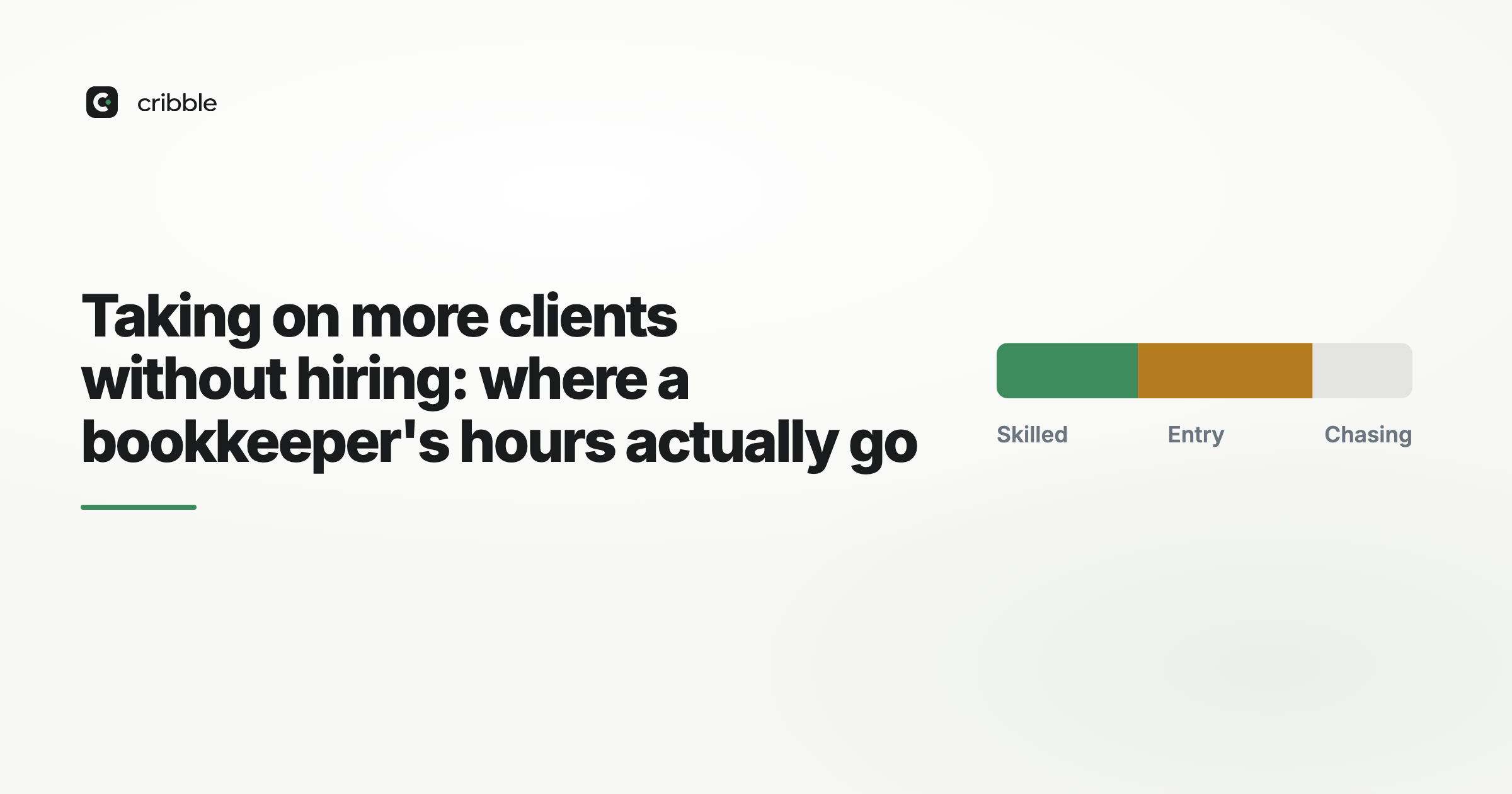
The constraint on a bookkeeping practice is almost never demand. It's that the person doing the work has a fixed number of hours, and taking on another client means either finding hours or hiring — and hiring is a step change in cost and management overhead that one extra client doesn't justify.
So the practical question is where the existing hours go, and which of them are producing value a client would pay more for.
The three categories
Chargeable and skilled. Management accounts, VAT returns, advice on what the numbers mean, the conversation where you tell a client their margins are slipping. This is what clients value and what they'd struggle to replace.
Chargeable and unskilled. Data entry, filing, chasing documents. Billed, usually, but billed at a rate that reflects it being typing. Nobody chose this profession for it.
Not chargeable at all. Chasing clients for the paperwork they promised. Re-doing something because the document arrived late. Explaining for the fourth time which receipts you need.
The second and third categories are where growth capacity is hiding.
The chasing problem
Ask most bookkeepers what actually costs them time and they don't say data entry. They say chasing.
The client who sends a shoebox of receipts on the 28th. The one who photographs things at an angle in bad light. The one who forwards a month of supplier emails in a single thread with no context. The one who doesn't respond until you've asked three times.
This time is almost entirely unbillable, and it's the reason a client who looks profitable on paper isn't. The engagement was priced on the work; the cost is the work plus the extracting.
What changes with volume
The awkward part: chasing scales linearly with clients, while the skilled work has some economy of scale.
Ten clients means ten sets of chasing. Twenty means twenty. The tenth client doesn't make the eleventh easier, which is why practices hit a ceiling that feels arbitrary — you're at capacity but the actual accounting work would fit in half the time.
Where the hours can come back
Standardise how documents arrive. The single biggest lever. A client who forwards invoices to one address as they arrive costs a fraction of one who assembles a folder at month-end. The difference isn't effort on their side — it's habit.
Worth building into onboarding rather than raising later. A process explained at the start is a process; introduced in month six it's a complaint.
Stop re-keying. Whatever automates entry, the value isn't only the typing time. It's that entry can happen continuously rather than in a block, which means client queries happen while the purchase is still recent and answerable.
Charge for the chasing, or price it in. Some practices bill differently for clients who supply documents late or badly. Others simply price those engagements higher. Either is more honest than absorbing it and wondering why margins are thin.
Be specific about what "we'll handle the bookkeeping" means. Much unbillable time comes from a scope that was never drawn. If receipt collection is the client's job, it should say so in writing.
The bit worth being honest about
Automating data entry doesn't automatically create capacity. It creates availability — which turns into capacity only if the freed hours go somewhere deliberate.
If four hours a week come back and get absorbed into working slightly less frantically, that's a real quality-of-life improvement and it isn't growth. Turning it into growth means deciding in advance what those hours are for: taking a client, doing advisory work you currently decline, or building something repeatable.
Worth deciding before the hours arrive, because unallocated time gets consumed by whatever is loudest.
A useful exercise
For one week, log your time in the three categories above. Not precisely — twenty-minute blocks is enough.
Most people find the split is worse than they expected, and that the largest single line is something they wouldn't have named if asked in advance.
Then ask of the biggest non-skilled line: is this something the client should be doing, something software should be doing, or something priced too low?
Usually it's one of the three, and usually it's fixable without hiring.
Cribble reads client documents as they arrive and posts the data, with per-field confidence so review is targeted rather than a full re-read. Useful mainly for practices where entry volume is the ceiling.